
Setting-Specific Vocabulary Banks for 11+ Descriptive Writing
Word banks organised by setting — forest, coast, city street, empty house, school corridor, and mountain peak — with nouns, verbs, adjectives, and sensory words for each. Includes a before-and-after paragraph and a method for building your own personal vocabulary bank from your reading.
In this article
Why Setting Vocabulary Transforms Descriptions
Most 11+ stories have a setting problem, not a plot problem. The ideas are often original and the structure is sound, but the descriptions are generic: "the forest was dark and creepy," "the beach was beautiful," "the old house was spooky." These descriptions tell the reader almost nothing specific, and they signal to an examiner that the student's vocabulary is limited.
The fix is surprisingly straightforward: build a mental word bank for each setting you're likely to encounter. When you know that a forest has bracken and canopy, that the coast has shingle and undertow, that an empty house has cobwebs and mildew, you can write with the kind of specificity that makes a reader feel they're actually there.
This guide gives you organised word banks for six settings that appear regularly in 11+ prompts. Each bank includes nouns (the things in the setting), verbs (what things do there), adjectives (what things look, sound, smell, and feel like), and sensory details. At the end, you'll find a method for building your own personal bank from your reading — because the best words are always the ones you encounter naturally.
The Forest
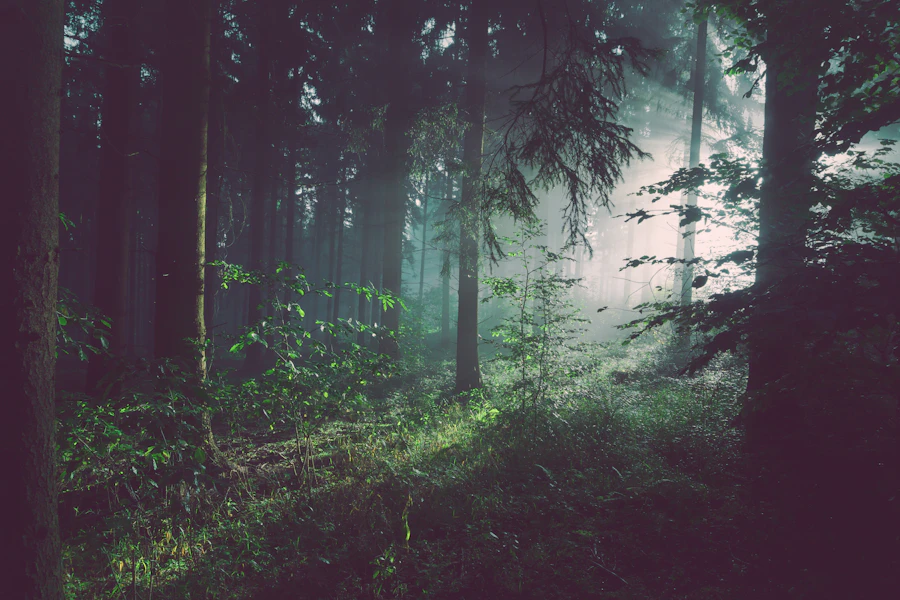
The forest is one of the most common 11+ settings, appearing in adventure stories, fairy tales, and mystery prompts alike. Generic descriptions rely on "dark," "leafy," and "quiet." Specific descriptions use the language of the forest itself.
Nouns
- canopy, bracken, undergrowth, glade, hollow, root, bark, moss, fern, thicket, deadfall, copse
Verbs
- filtered (light filtered through the leaves), rustled, creaked, dappled, loomed, tangled, sheltered, swallowed, enclosed
Adjectives and Sensory Words
- earthy, damp, dim, cathedral-like, ancient, towering, cathedral-quiet, musty, twisted, gnarled, resinous
Before: The forest was dark and scary. The trees were tall and there were lots of them. It was hard to see. After: The canopy closed above her, filtering the light into thin needles that barely reached the forest floor. Beneath her feet, the bracken was thick and wet, and the smell of damp earth rose with every step. In the hollow of an ancient oak, something rustled.
The Coast
Coastal settings carry a particular energy — the meeting point of two worlds. The vocabulary of the sea is rich and specific, and using even two or three precise words lifts a coastal description far above the ordinary.
Nouns
- shingle, surf, breakwater, estuary, tide pool, sandbar, driftwood, kelp, cliffs, cove, undertow, spray, headland, rockpool
Verbs
- surged, retreated, churned, eroded, crashed, foamed, swirled, dragged, glittered, lapped
Adjectives and Sensory Words
- brackish, salt-stung, foam-flecked, grey-green, relentless, vast, wind-scoured, pewter, desolate, rhythmic
Before: The beach was nice. The waves were big and the sand was soft. The sea looked lovely. After: The wind hit them the moment they reached the headland — cold and salt-stung, carrying the smell of seaweed and open water. Below, the surf churned over the shingle in long, relentless strokes. A sheet of foam-flecked grey-green stretched to the horizon.
The City Street
Contemporary stories set in cities often suffer from the blandest descriptions: "the street was busy," "there were lots of people." City vocabulary is about density, contrast, and the constant movement of modern life. These words capture what makes a city feel real on the page.
Nouns
- pavement, kerb, alleyway, scaffolding, awning, neon, siren, exhaust, gutter, shopfront, junction, pedestrian crossing
Verbs
- streamed, jostled, blared, glowed, reflected (puddles reflected the neon signs), rattled, throbbed, weaved, rushed, flickered
Adjectives and Sensory Words
- grimy, gleaming, neon-lit, pungent, crowded, anonymous, relentless, rain-slicked, diesel-scented, narrow
Before: The street was noisy and busy. There were lots of shops and people everywhere. After: She stepped out of the doorway into the full noise of the city — sirens and diesel fumes and the steady throb of a music speaker somewhere above the awnings. The rain-slicked pavement mirrored the neon signs in orange and white, and the stream of pedestrians moved around her without a glance.
The Empty House
Empty house settings appear constantly in mystery, ghost, and adventure stories. The key to writing them well is sensory detail — what can be heard, smelled, and felt in a space that should be silent. These words carry an atmosphere that generic descriptions can't match.
Nouns
- cobweb, floorboard, banister, skirting board, threshold, windowsill, mantelpiece, mildew, plaster, shutter, attic, cellar
Verbs
- groaned, settled (old houses settle at night), creaked, gathered (dust gathered on the mantelpiece), dripped, swung, draped, hung, echoed
Adjectives and Sensory Words
- musty, abandoned, still, dusty, cold, close, draughty, silent, hollow-sounding, peeling, moth-eaten, damp
Before: The house was spooky and old. It smelled bad and was very quiet. After: Dust lay thick on the mantelpiece, undisturbed. The floorboards groaned with every step, and the air carried the faint smell of mildew — sweet and stale at once. Somewhere upstairs, a shutter swung on its hinge, then settled.
The Mountain Peak
Mountain settings appear in adventure stories, historical fiction, and fantasy alike. The vocabulary of high places is about exposure — the absence of shelter, the physical challenge, and the scale that dwarfs the human characters. These words capture that.
Nouns
- ridge, summit, scree, crevasse, ledge, outcrop, cairn, gust, altitude, cloud-line, boulders, precipice
Verbs
- swept (the wind swept across the ridge), plunged (the path plunged away to the left), stretched (the valley stretched out below), buffeted, clawed, scrambled, thinned (the air thinned), dropped
Adjectives and Sensory Words
- exposed, thin-aired, vast, icy, raw, treacherous, wind-blasted, vertiginous, silent, remote
Before: The mountain was very high and the wind was strong. They could see a long way down. After: The wind hit the ridge without warning — not a gust but a sustained force that pushed against them as though the mountain were trying to turn them back. Below, the scree fell away to a valley so distant it looked like a map. The air was thin and cold, and every breath required a little more effort than the last.
Build Your Own Vocabulary Bank
The six banks above will see your child through most 11+ prompts. But the most powerful vocabulary a student can bring into an exam is the kind they've absorbed from real books — because those words feel genuinely owned, not borrowed.
Here's a method that works. Whenever your child reads a passage set somewhere interesting — a harbour, a jungle, a Victorian marketplace — ask them to pause and extract three to five setting-specific words into a notebook. A simple layout works best:
- Setting: Victorian marketplace
- Words: cobblestones, gaslight, costermonger, offal, hubbub
- One sentence: The gaslight turned the cobblestones amber, and the hubbub of the costermongers filled every corner of the market square.
Over a term of regular reading, this notebook becomes a genuinely personal vocabulary bank — one that's far more likely to show up naturally in exam writing than a list memorised from a page. The sentence-writing step is essential: words used in context stick; words memorised in isolation often don't.
Before an exam, a ten-minute review of the notebook is worth more than an hour of new word lists. Your child is reminding themselves of vocabulary they already know, not trying to absorb anything new under pressure.
Frequently Asked Questions
Stay Updated with PenLeap
Get the latest tips on creative writing, 11+ exam preparation, and AI-powered learning straight to your inbox. Join thousands of parents and students.
Subscribe to NewsletterFree • No spam • Unsubscribe anytime
Ready to Improve Your Writing?
Get instant AI feedback on your 11+ creative writing. Join thousands of students already using PenLeap.
Start FreeNo credit card required • Free to start